
Multivariable Calculus : Linear approximation and Taylor's theorems, Lagrange multiples and constrained optimization, multiple integration and vector analysis including the theorems of Green, Gauss, and Stokes.
The course provides an introduction to multivariable calculus. It begins with a study of geometrical objects in several dimensions, including vectors, lines, planes, and quadric surfaces. It continues with differentiation and integration of vector functions, with some applications. Then there is a study of partial differentiation, and its application to problems of minimization and maximization, including the method of Lagrange multipliers. The next part of the course deals with integration of functions of two and three variables, emphasizing Fubini’s Theorem and its applications. The last section deals with Green’s Theorem, Gauss’ divergence theorem, and Stokes’ Theorem, and their applications.
At the conclusion of this course, it is expected that students will be able to do the following.
- Apply dot and cross products to describe relationships between points, lines, and planes.
- Describe the motion of an object in 3 dimensions.
- Apply partial derivatives to approximate functions using Taylor’s formula, tangent planes, and
differentials; and solve constrained and unconstrained optimization problems.
- Calculate integrals of functions of several variables in rectangular, cylindrical, and spherical
coordinates
- Calculate volumes and centers of mass
- Calculate flow and divergence using the theorems of Gauss, Green, and Stokes
- Justify your reasoning in presenting solutions to problems
Calculus: Early Transcendentals, 14th ed. by G. B. Thomas Jr. Pearson. ISBN 978-1292253220. Chapter 12, 13, 14, 15 and 16 will be covered.
Purchase of the textbook is not necessary. Slides with complete lessons will be posted on Canvas.
HOMEWORK: Homework will be assigned on-line every week via Webwork. Each homework will be due on Tuesdays at 11:59 PM (except during class recesses or as announced otherwise in class) at which time the solutions will also become available.
QUIZZES: There will be five quizzes of 20 minutes on Thursdays. Tentative dates are Aug 28, Sep 11, Oct 9, Oct 23 and Nov 27. One lowest quiz score will be dropped.
MIDTERMS: There will be two midterms of 75 minutes. Tentative dates are Sep 24 (Wednesday) and Nov 14 (Friday). There’s no dropping for midterm.
FINAL EXAM: The final exam will cover all course materials and will be administered during the final exam period (the exact date will be announced later.) for 2 hours and 50 minutes. All students must take the final examination and should not plan for travel during the final exam period before all the exam dates are fixed. No earlier or late exam will be allowed for travel plans.
Grades
Final grades will be calculated using whichever of the following weights yields the higher grade.
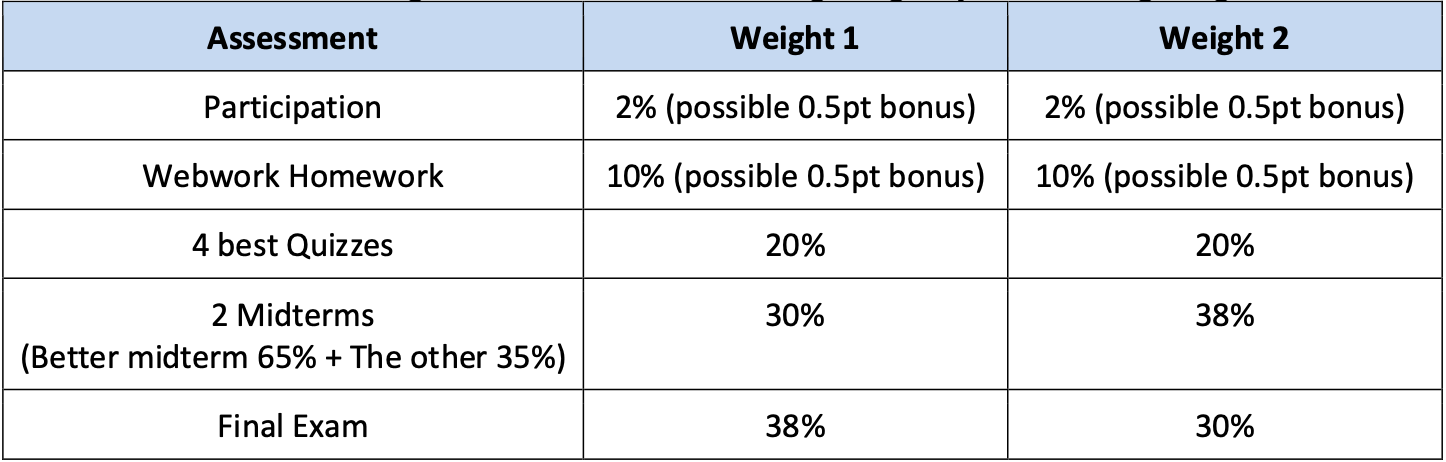
CIOS Bonus: When the participation to the survey for both Lecture and Studio is above 85%, there will be 1pt bonus awarded to the entire class. (Total 2 points, out of 100, bonus in the final grade is possible.)
A midterm grade will be assigned around September 30. A satisfactory grade will be assigned to all students with a midterm average of 70% or higher.
Letter grades will be determined based on the usual intervals. A: 90% and higher, B: [80%, 90%), C: [70%, 80%), D: [60%, 70%), F: [0%, 60%). For example, a final grade of 89.99% is converted into a B, a final grade of 79.99% is converted into a C, and so on. There will be NO changes to these intervals because there will be an appropriate curve or make-up test depending on the average for each test. No individual curve, extra credits, or make-up exam (except for absences.)
PARTICIPATION: Attending class is important. Class attendance and participation for both lectures and studios will be recorded and scored on a 0-2.5 scale. The scale is determined as follows: 2.5 points for above 90% attendance for both Lecture and Studio, 2 points for above 80% attendance for both Lecture and Studio, and 1 point for above 80% in one and 80-60% in the other, and 0 otherwise. The participation grade will be added onto the final average with a possible 0.5 bonus at the end of the term, affecting all borderline grades. Late arrivals and early departure will be also noted.
Students are expected to maintain the highest standards of academic integrity. All work submitted must be original and properly cited. Plagiarism, cheating, or any form of academic dishonesty will result in immediate consequences as outlined in the university's academic integrity policy.
This is a Core IMPACTS course that is part of the STEM area
Core IMPACTS refers to the core curriculum, which provides students with essential knowledge in foundational academic areas. This course will help master course content, and support students’ broad academic and career goals.
This course should direct students toward a broad Orienting Question:
- How do I ask scientific questions or use data, mathematics or technology to understand the universe?
Completion of this course should enable students to meet the following Learning Outcomes:
- Students will use the scientific method and laboratory procedures or mathematical and computational methods to analyze data, solve problems and explain natural phenomena.
Course content, activities and exercises in this course should help students develop the following Career-Ready Competencies:
- Inquiry and Analysis
- Problem-Solving
- Teamwork