Foundations of Data Analysis

Last Updated: Fri, 12/19/2025
Course prefix:
MGT
Course number:
6500
Semester:
Spring
Academic year:
2026
Course description:

To introduce participants to a problem-driven approach to assembling, analyzing, and taking action on data. With the Problem-Plan-Data-Analysis-Conclusions (PPDAC) Cycle and Gartner’s Analytics Maturity Model (Descriptive → Diagnostic → Predictive → Prescriptive Analytics) as frameworks, fundamental concepts for the analysis of data will be covered, including descriptive statistics, visualizations, probability and distributions, confidence intervals, hypothesis testing, and regression analysis/predictive analytics. Knowledge of the “whys” behind these tools facilitates rigorous data-driven decision-making. 

Course learning outcomes:

The learning objectives of this course are:

  1. To understand and execute the process of decision-making based on data;
  2. To assemble, summarize, visualize, and analyze data arising in decision making; and,
  3. To conceptualize and interpret models for diagnostic, predictive, and prescriptive analytics.
Required course materials:
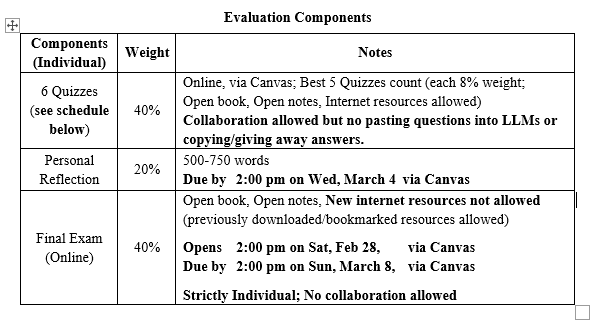
Grading policy:


Attendance policy:

Class attendance will not be monitored or graded. Students in the online section may also attend the in-person section.

Academic honesty/integrity statement:

Students are expected to act and must also expect their peers to act according to the highest ethical standards, as outlined in the honor code at http://www.policylibrary.gatech.edu/student-affairs/academic-honor-code.             

  • You are not allowed to seek or receive previous class material (including class notes, readings, quizzes, exams, class recordings, etc.).
  • While collaboration is allowed for the Quizzes (submissions are individual), simply pasting questions into LLMs or copying/giving away answers is not allowed.
  • Note that collaboration is not allowed for the Personal Reflection and the Final Exam.
  • Sharing/posting or offering to share/post any course material or recordings (except sharing your class notes with your classmates) – whether during or after the end of the course – will violate the honor code and is not allowed. 
Instructor First Name:
Ravi
Instructor Last Name:
Subramanian
Section:
EMA, EMO
CRN (you may add up to five):
24559
34165
Department (you may add up to three):

Legal Aspects of Business

Last Updated: Thu, 12/04/2025
Course prefix:
MGT
Course number:
2106
Semester:
Spring
Academic year:
2026
Course description:

Course Description:

MGT 2106 will introduce you to the American legal system as it relates to business. The course will cover constitutional law, administrative law, torts, contracts, dispute resolution, property, business formation, employment matters, and ethical issues.


Prerequisite:

There are no prerequisites for this course.


Course learning outcomes:

Course Learning Outcomes:

At the end of the course, you should be able to do the following:

  • Demonstrate knowledge of legal theories applicable to jurisdiction, alternative dispute resolution, torts, product liability, contracts, agency, employment, and business organizations
  • Diagnose legal issues from a set of facts describing a business situation
  • Identify and formulate relevant legal theories for legal issues deduced from a set of facts describing a business situation
  • Predict likely outcomes/consequences to legal issues in a business situation
  • Generate possible solutions and strategies to legal issues
  • Explain the risk to a business entity that legal issues present
  • Communicate in a professional manner, using logic and reasoning the diagnosis of legal issues, relevant legal theories, and likely consequences
  • Demonstrate knowledge of ethical standards and frameworks appropriate for business
  • Identify business ethical dilemmas and use ethical frameworks (as well as logic and reasoning) to respond appropriately
Required course materials:

Roger LeRoy Miller, Business Law Today: The Essentials, 12th edition (McGraw Hill Irwin).
ISBN-13: 978-0-357-03817-8 

All class slides are posted in Canvas.

Grading policy:

Evaluation

Attendance, Class Participation and Assignments                                  20%

First Exam                                                                                                      20%

Second Exam                                                                                                  20%

Third Exam                                                                                                     20%     

Final Exam                                                                                                     20%


Your final grade will be based on a combination of attendance/class participation/assignments and the four exams. Please note how heavily attendance/class participation is weighted in this course. 


Grade Scale:                                              

             A                     90-100             

            B                     80-89   

            C                     70-79

            D                     60-69

F                      59 and below

Attendance policy:

Required.

Academic honesty/integrity statement:

Students are expected to maintain the highest standards of academic integrity. All work submitted must be original and properly cited. Plagiarism, cheating, or any form of academic dishonesty will result in immediate consequences as outlined in the university's academic integrity policy.

Instructor First Name:
Mariangela
Instructor Last Name:
Corales
Section:
D
CRN (you may add up to five):
31465
Department (you may add up to three):

Project Management

Last Updated: Mon, 11/17/2025
Course prefix:
MGT
Course number:
6450
Semester:
Spring
Academic year:
2026
Course description:

Every product ever developed, every building ever built, every program ever written, every app that was ever downloaded is the result of a project 

A project is a temporary endeavor undertaken to accomplish a unique product, service, or result.  

Project Managers play an essential role in the smooth and successful execution of initiatives. Often working in teams, they ensure project alignment with business objectives, secure and track resource use, keep channels of communication open with all important stakeholders, and apply best practices of the project management field to bring projects in on time and budget and to specification. Interpersonal skills, including working in and managing teams, are essential to success in this profession. Project management principles and practices are used in many industries, e.g., information systems development, construction, automobile and aircraft manufacturing, consumer electronics, and computer hardware, among others. 

MGT 6450 explores the principles, concepts and practices associated with modern project management. The course elements review predictive and agile/adaptive frameworks based on course material drawn from the Project Management Institute (PMI) Project Management Body of Knowledge (PMBOK) and Scrum. Students will be expected to understand and apply course content in project practicums via in-class discussions, case-based assignments, and working as a team to complete an adaptive/agile project simulation and closure report, and a capstone project research project exploring the reality of project management in contemporary organizations. Students will also learn the basics of a project management software system, applying that system in managing the capstone assignment as a project.  

Course learning outcomes:
  1. Understand and use concepts, techniques, and terminology common in project management frameworks including the PMBOK, PRINCE2, and Agile methods.  
  2. Understand the importance of the product and project lifecycle and its constituent components 
  3. Understand the importance of project leadership including developing effective team dynamics and culture 
  4. Understand the importance to organizational leadership for the selection and alignment of program and project requirements and deliverables to an organization’s strategic plans 
  5. Articulate the criteria for selecting and implementing an appropriate project management methodology including predictive and agile/adaptive frameworks 
  6. Understand how to employ Scrum and Kanban effectively  
  7. Develop a plan to identify and manage stakeholder engagement 
  8. Develop the appropriate criteria to select a project 
  9. Develop the necessary project artifacts to provide effective project management including project activities, Work Breakdown Structure, network diagrams, risk registers, budgets, and RACI charts, Scope management plan, communication plan, and other relevant project artifacts or tools. 
  10. Create a project plan in its various elements according to PMBOK standards, including, for example, a charter, stakeholder analysis, risk management plan, communications plans, etc.  
  11. Monitor, control, manage and report on key project metrics based on analytical techniques including project budgets, earned value analysis, critical path, and risk analysis 
  12. Describe how project management practices differ depending on industry, size, etc. and what things never change 
  13. Use common project management software to develop and track a team project to a successful conclusion 
Required course materials:
  • The required text is Information Technology Project Management, 9th ed., by Schwalbe https://www.cengage.com/c/information-technology-project-management-9e-schwalbe/9781337101356PF/  It’s available through the bookstore and, since it has been out for a while, there may be used copies available. 
  • The Scrum Guide by Schwalbe and Sutherland – provides an overview of the basic elements of Scrum. The PDF is available as a download https://scrumguides.org/docs/scrumguide/v2020/2020-Scrum-Guide-US.pdf or will be available as a Canvas file for download. 
  • Project Management Case Studies – 5th Edition – by Harold Kerzner – periodically short cases (2 to 4 pages) will be assigned as pre-read. The cases will be referenced for in-class discussions and assignments. The referenced case studies can be accessed via the Canvas Reading Lists for this course.  
  • Team Project document -  A case studies have been developed for use in this class and teams will be assigned to either case study.   
  • Smartsheet - Licensed access to a project management tool will be provided early in the semester. You will be expected to use Smartsheet to manage the PMIP semester project. An assignment will require you to acquire a basic knowledge of Smartsheet using a Tutorial accessible as a Canvas file. 
  • Note: No specific software skills are evaluated on tests in this course this term although they may be demonstrated and a homework assignment given, depending on available resources.  
  • Other resources, including videos, documents, templates, and web sites, are available through the Resources tab on the course website in Canvas and in the section below.
Grading policy:
  1. Midterm exam  - 20% -  The midterm exam focuses on the first half of the class material.  
  2. Final exam  - 20% - The final exam focuses on the second half of the class material and other general course material
  3. Pre-class quizzes - 15% - Pre-class short open book quizzes due prior to class based on the readings for a class 
  4. Class Attendance and Participation  - 10% - This is a graduate class. It is my assumption that you are in this class because you truly want to learn the subject as this material will help you in many ways during your professional development. I will provide you with direct feedback on your level of participation and expect you to come to class. A maximum of 3 absences will be accepted to get full credit
  5. Homework/In class discussion participation - 15% -  Various homework assignments and in class discussions covering project management knowledge, skills, and tools relevant to the MetroHealth case study or other class activities will be assigned. The grades will be determined based on the homework grading rubric.  
  6. PMIP Team Project report and presentation - 20% - The Project Management in Practice project requirements are detailed in the assignment details and the report template. The project grade will be determined by the quality of the report and the team's in-class presentation summary of their report. Individual grades will be adjusted based on peer evaluations of team members' participation and contribution to the report and presentation.  
  7. Total - 100% 
Attendance policy:

Class Attendance and Participation  - 10% - This is a graduate class. It is my assumption that you are in this class because you truly want to learn the subject as this material will help you in many ways during your professional development. I will provide you with direct feedback on your level of participation and expect you to come to class. A maximum of 3 absences will be accepted to get full credit 

Academic honesty/integrity statement:

Students are expected to maintain the highest standards of academic integrity. All work submitted must be original and properly cited. Plagiarism, cheating, or any form of academic dishonesty will result in immediate consequences as outlined in the university's academic integrity policy.

Instructor First Name:
Juan
Instructor Last Name:
Perez
Section:
Spring 2026
CRN (you may add up to five):
28652
29870
Department (you may add up to three):